
Understanding the Psychology of Hoarding: How to Help Someone You Love
Understanding the Psychology of Hoarding: How to Help Someone You Love

When most people think about hoarding, they picture rooms filled with boxes, clothing, papers, household items, or belongings that have accumulated over many years. What isn't always visible is the emotional struggle behind those possessions.
For someone experiencing hoarding disorder, getting rid of an object may be far more complicated than simply deciding whether to keep it or throw it away. Possessions can become connected to memories, feelings of security, fears about the future, or intense anxiety surrounding the possibility of making the wrong decision.
Understanding this is important—especially when the person struggling is someone you love.
At Steri-Clean, we've helped individuals and families facing challenging hoarding situations for years. One of the most important lessons is simple: successful hoarding cleanup isn't just about removing belongings. It starts with treating the individual with dignity, patience, and respect.
What Is Hoarding Disorder?
Hoarding disorder is a recognized mental health condition characterized by persistent difficulty discarding or parting with possessions, regardless of their actual value. The idea of getting rid of possessions can cause significant distress.
Over time, belongings may accumulate until living spaces can no longer be used as intended. A bedroom may become primarily storage. Hallways can become difficult to navigate. Kitchens, bathrooms, stairs, and exits may eventually become obstructed.
But the physical accumulation is only part of the issue.
People struggling with hoarding may have powerful emotional attachments to their possessions. An object that seems insignificant to someone else may represent an important memory, potential future need, or sense of security.
That's why telling someone to "just throw everything away" rarely addresses the underlying problem.
How Does Hoarding Develop?
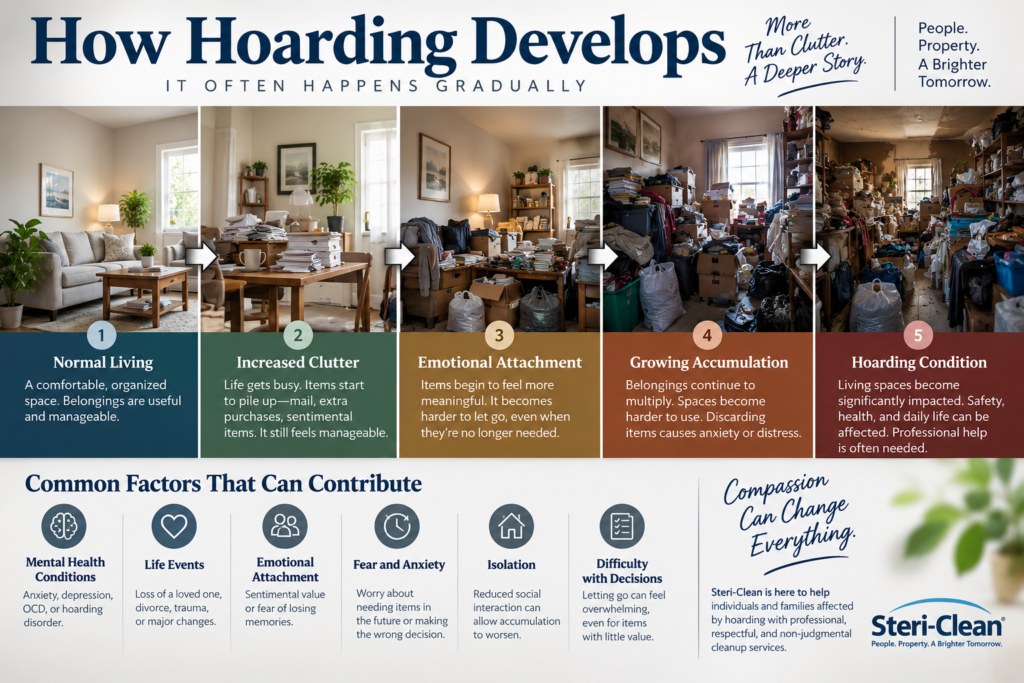
There isn't one single cause of hoarding disorder. Researchers believe several psychological, behavioral, environmental, and biological factors may contribute.
For some people, hoarding behaviors gradually develop over many years. Others may notice them becoming more severe following a stressful or traumatic life event.
Major life changes such as the death of a loved one, divorce, financial difficulties, isolation, or other emotionally difficult experiences may sometimes contribute to or intensify existing behaviors.
People who struggle with hoarding may also experience difficulties with decision-making and organization. Questions that seem simple—"Do I need this?" or "Should I throw this away?"—can become emotionally exhausting.
Fear can play a role as well. Someone may worry that an item will eventually become useful and that discarding it now will lead to regret later.
As possessions continue accumulating, the situation can become overwhelming. The person may recognize that something needs to change while simultaneously feeling unable to begin.
Why Forced Cleanouts Can Be Counterproductive
When family members discover the extent of a hoarding situation, their first instinct may be to clean everything immediately.
That reaction is understandable, particularly when the home has become unsafe.
However, removing someone's possessions without their involvement can create significant distress and damage trust. Unless there is an immediate safety issue requiring intervention, approaching the situation collaboratively is often more constructive than treating it simply as a cleaning problem.
Hoarding disorder involves much more than clutter.
The ultimate objective should be helping create a safer living environment while respecting the person who lives there.
How to Help a Friend or Loved One Who Is Hoarding
If someone you care about is struggling with hoarding behaviors, begin with conversation rather than confrontation.
Avoid language such as "junk," "garbage," or "mess." Those descriptions may seem accurate from your perspective, but they can feel judgmental to someone who has an emotional attachment to those belongings.
Instead, focus on specific concerns.
You might talk about making sure there is a safe pathway through the home, improving access to important rooms, reducing fall hazards, or making it easier to use the kitchen.
Most importantly, listen.
Ask what your loved one wants to accomplish and what makes the process difficult for them. Small, achievable goals can feel much less overwhelming than trying to solve the entire situation at once.
Professional mental health support can also be valuable. A qualified mental health professional familiar with hoarding disorder can help address the thoughts, emotions, and behaviors contributing to the condition.
Recognizing When a Hoarding Situation Has Become Unsafe
As accumulation becomes more severe, hoarding can create practical safety and sanitation concerns.
Blocked entrances and exits can make emergency access difficult. Excessive materials may create trip-and-fall hazards. Depending on the condition of the property, there may also be spoiled food, animal waste, rodent activity, insects, mold, odors, or other contamination.
At this stage, the situation may require more than traditional household cleaning.
That's where professional hoarding cleanup services can help.
Steri-Clean's Compassionate Approach to Hoarding Cleanup
Steri-Clean understands that we're not simply cleaning a property—we're helping a person.
Our teams have extensive experience working in difficult and sensitive cleanup environments. We approach hoarding situations without judgment and work to help individuals and families move toward cleaner, safer living conditions.
Depending on the situation and the client's goals, professional hoarding cleanup may involve sorting and organization, removal of unwanted items, deep cleaning, sanitization, odor removal, and addressing areas affected by biological or other contamination.
Every situation is different. That's why the process should be tailored to the property and, whenever possible, the needs of the person involved.
Progress Doesn't Have to Happen Overnight
Helping someone with hoarding disorder can be frustrating, emotional, and exhausting for everyone involved.
Remember that progress doesn't necessarily mean transforming an entire house in one day.
Sometimes progress is clearing one hallway.
Sometimes it's making a kitchen functional again.
And sometimes the most important first step is simply having a conversation without judgment.
If a friend or family member is struggling with a hoarding situation, approach them with patience and compassion. Encourage appropriate professional support for the psychological side of hoarding, and when the physical cleanup becomes too difficult or overwhelming to manage alone, professional help is available.
Steri-Clean Is Here to Help

For decades, Steri-Clean has helped individuals and families navigate challenging cleanup situations with compassion, discretion, and respect.
If you or someone you love is dealing with an overwhelming hoarding situation, you don't have to tackle the cleanup alone.
Contact Steri-Clean today to discuss professional hoarding cleanup services in your area. Our team can help you understand the cleanup process, evaluate the property, and determine the next steps toward creating a cleaner, safer, and more manageable living environment.
Compassion first. Cleanup second. A fresh start is possible.